

Why your customers add to cart and disappear (it's almost never the price)
TL;DR. A 70% cart abandonment rate is real, but it's hiding three completely different shopper behaviors: people who add to cart to check the real shipping price, people who add to cart as a bookmark while they wait for an answer, and people who add to cart, hit checkout, and bail when a surprise number appears. Most stores reach for the same fix — a longer Klaviyo abandoned-cart flow — and recover 8–12% of the revenue. The other 88% needs an upstream change in how the store presents shipping, answers questions, and handles the final step. This article gives you the data signature for each of the three buckets and the specific moves to make. The diagnostic takes about 15 minutes and runs in your Shopify admin.
Cart abandonment is three different behaviors

Here's how one Shopify operator we spoke with described what it actually feels like:
"I'm paying to get someone to the site. They add to cart. They hover over checkout. And then… gone. Like 99% of the time. G-O-N-E. It kills CAC, tanks ad ROI/ROAS, and makes it harder to build a good email list."
This is the most common version of cart abandonment in operator language: it feels like the shopper was about to pull the trigger, then vanished. The instinct is to do something — install another recovery tool, lengthen the abandoned-cart email sequence, add an SMS, drop in an exit-intent discount popup. Some of it works. Most of it doesn't, because abandonment is not one behavior. It's three.
The number itself is real. Baymard Institute, which has been documenting cart abandonment since 2006, puts the average documented rate at 70.22% across 50 studies. [1]
When you do break it apart, three distinct shopper patterns emerge:
- Bucket 1 — Price-checkers. They added an item to cart because that's the only way to see what shipping really costs to their address. They were never going to buy on this visit. The cart is a calculator, not a commitment.
- Bucket 2 — Pause-and-thinkers. They liked the product, added it, and then opened a tab. They had an unanswered question — about fit, shipping speed, returns, materials, anything — and the product page didn't answer it. The cart became a bookmark while they thought about it.
- Bucket 3 — Checkout-shocked. They were sold. They added, started checkout, typed their email, hit shipping address. Then a number — usually shipping, sometimes a handling charge or tax line — appeared, and they closed the tab.
Industry abandoned-cart tools — Klaviyo, Omnisend, ReConvert, the long tail of recovery apps — treat all three buckets as the same thing and try to win them all back with the same email or SMS. They recover roughly 8–12% of carts on average, [2] which is a real, legitimate result. It's also a ceiling. The math is mechanical: if your dominant bucket is price-checkers, no email is going to convert someone who wasn't buying in the first place. The recovery tool isn't broken. It just can't fix the upstream cause.
The work is to figure out which bucket dominates yours, then fix the cause for that bucket. The fixes are different — sometimes opposite — for each one.
How to tell which bucket dominates yours
You can do this part in 15 minutes with nothing but Shopify Analytics. Open Admin → Analytics → Reports and pull the last 30 days of these three numbers:
- Add-to-cart rate — sessions that added at least one item, divided by total sessions
- Reached-checkout rate — sessions that reached the checkout flow, divided by ATC sessions
- Reached-checkout → Purchase rate — sessions that completed a purchase, divided by reached-checkout sessions
The pattern between those three numbers is your fingerprint.

In plain English:
- High ATC + low reached-checkout. Lots of people are adding items, but few are starting checkout. Most of those carts sit idle. This is Bucket 1 or Bucket 2 dominant. The shoppers are using the cart as either a calculator or a bookmark — they're not actually attempting to buy.
- Healthy ATC + healthy reached-checkout + low purchase. People commit, start checkout, then bail at the last step. This is Bucket 3 dominant. Something at checkout is changing their mind.
- Weak ATC and weak everything downstream. This isn't a cart problem at all. This is the trust or audience problem from a different diagnosis.
If your numbers fall in the third pattern — weak across the board — fix that first. The cart problem comes after the upstream problem. Trying to solve cart abandonment when the underlying issue is that the wrong audience is arriving (or that the right audience doesn't trust your store yet) is wasted effort.
For everyone else, read on. Here's what each bucket actually wants from you.
Bucket 1 — The price-checkers
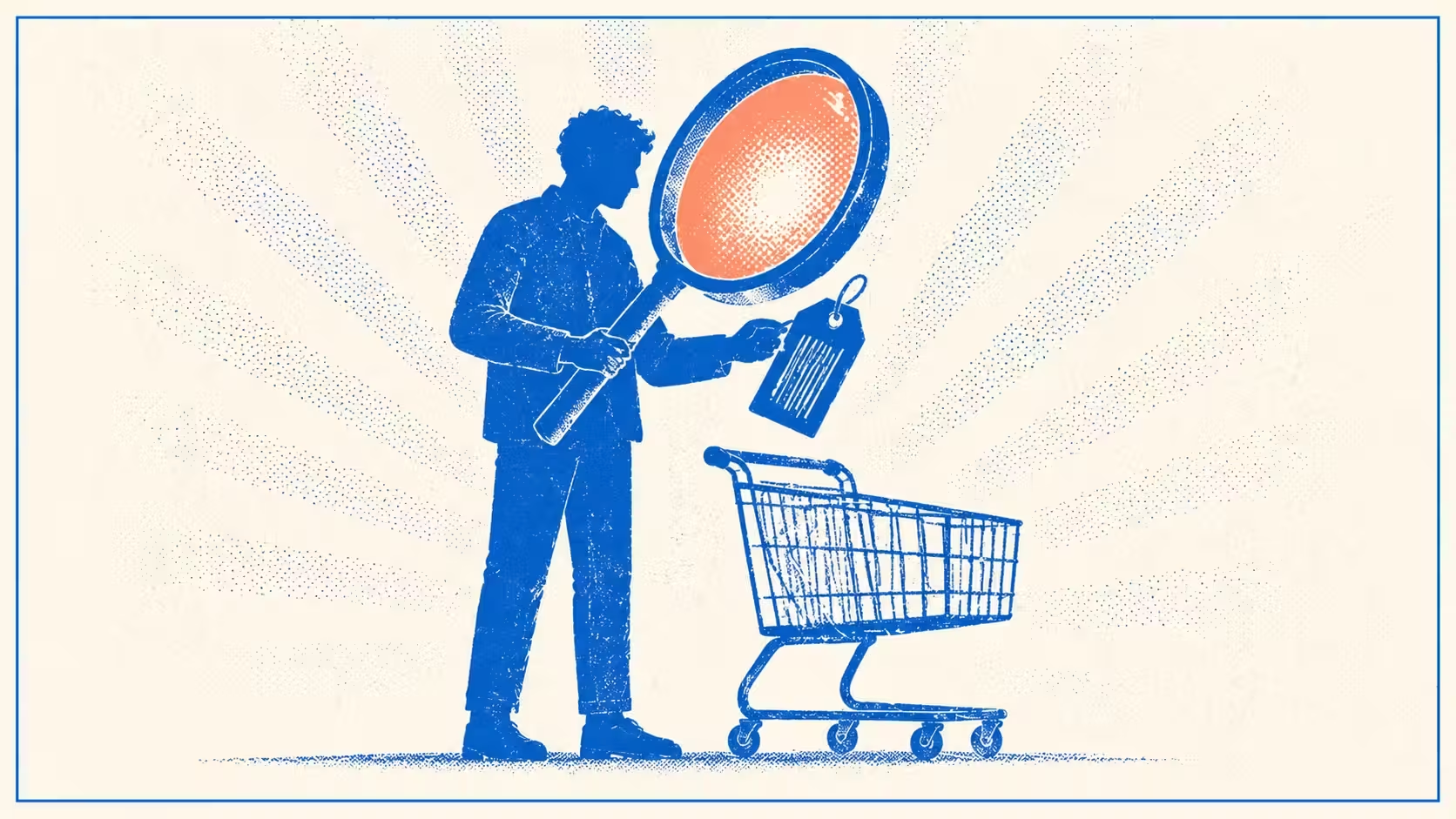
There's a candid behavior almost every shopper has admitted to at some point: adding an item to cart not to buy it, but to find out what shipping costs to their address. The store doesn't show shipping until checkout. The cart becomes the only way to extract that number. Once they have it, they leave. They were never trying to buy.
Baymard's research backs this up: 43% of US online shoppers have abandoned a cart because "I was just browsing / not ready to buy." [3] Inside that segment, a meaningful share are doing exactly this — using the cart as a price-discovery tool.
The fingerprint
- High add-to-cart rate (sometimes well above 8%)
- Very low reached-checkout rate (often under 30%)
- Carts sit idle and never get touched again
- Abandoned-cart emails get opened but rarely converted
The signal is high engagement upstream, no engagement downstream. They're interested enough to put something in the cart, but never interested enough to attempt checkout.
The fix is upstream of the cart, not at recovery
The fix isn't a longer abandoned-cart email. It's removing the reason the cart was used as a calculator in the first place. Make shipping cost visible before anyone has to add an item:
- Show a shipping estimator on the product page. A small "Calculate shipping" widget that takes a ZIP or postcode and returns a cost. Most Shopify themes don't include this by default, but several apps add it cleanly, and it pays for itself the moment it removes the price-checking ATC.
- Show a flat shipping policy line in the product page hero. Something concrete: "Ships from Brooklyn. Flat $5.95 to anywhere in the US. Free over $75." No estimator needed if your shipping is simple.
- Show your free-shipping threshold prominently. "Spend $X more for free shipping" both motivates higher AOV and de-risks the visit. The shopper now knows the price floor before they commit anything to the cart.
- If you sell internationally, name the regions you ship to. Cart-as-calculator behavior is highest among international shoppers checking whether you'll even ship to them.
What doesn't work
Longer or sweeter abandoned-cart emails. They're aimed at the wrong shopper. The price-checker isn't waiting for an email — they got the information they came for and moved on.
Bucket 2 — The pause-and-thinkers

Some shoppers are genuinely interested. They like the product. They add it to cart. Then they hesitate, because somewhere on the product page there was an unanswered question:
- Will it fit?
- When does it ship?
- Can I return it if it doesn't work?
- Is this safe for my dog / my baby / my skin / my plant?
- Is this real wood / real leather / real silver?
The cart becomes a placeholder while they go look it up. They open a tab. They text a friend. They come back tomorrow — or never. As one operator put it, "the cart becomes a bookmark when commitment feels premature."
This is the bucket where Klaviyo abandoned-cart emails actually do work — but only if the email answers the unanswered question. Most automated flows don't. They send a generic "did you forget something?" message and a 10% discount code, neither of which addresses the real reason the shopper paused.
The fingerprint
- Moderate add-to-cart rate (4–7%)
- Low reached-checkout rate (often 30–50%)
- Carts sit idle for hours or days before either being recovered or expiring
- Recovery emails do convert at low single-digit rates — proof these shoppers had real intent
The fix is on the product page, not the cart
Build the product page to answer the question before it gets asked:
- Specs and dimensions, prominently and in plain English. Not buried in a spec sheet — visible without scrolling on mobile.
- A returns and refund summary that's actually visible. One sentence above the fold ("30-day free returns, no questions asked") beats a footer link to a policy page that nobody reads.
- Shipping ETA in plain English. "Ships within 2 business days, arrives in 3–5" tells the shopper everything they need to know about timing without requiring them to start checkout.
- A "Frequently Hesitated Questions" mini-FAQ. Not the generic FAQ. The 3–5 questions that come up in your support tickets and post-purchase surveys. These are the actual blockers between cart and checkout.
The deeper move
Read your support tickets. Run a post-purchase survey. The questions customers ask after they buy are the same questions other customers asked before they didn't. The most experienced Shopify operators we know describe post-purchase surveys as a non-negotiable — not for satisfaction scoring, but as the highest-signal, lowest-cost Conversion Rate Optimization (CRO) research input there is. Most stores don't run them. The ones that do consistently tell us it changed what they decided to optimize.
Bucket 3 — The checkout-shocked

This is the bucket every operator viscerally knows. The shopper added to cart. They started checkout. They typed their email and hit "Continue to shipping." The shipping cost loaded. And then the tab closed.
This is the bucket Baymard's data names most clearly. Among shoppers who had genuine intent (i.e. weren't just browsing), 39% abandoned because "extra costs too high (shipping, tax, fees)," and a further 14% because they "couldn't see/calculate total order cost up-front." [4] Combined, more than half the intent-positive abandonment is driven by surprise costs at the final step.
The fingerprint
- Healthy add-to-cart rate
- Healthy reached-checkout rate (often 50%+)
- Low reached-checkout → purchase rate (often under 30%)
- The drop happens inside the checkout flow, not before it
The fix is to stop being the surprise
The mechanic here isn't psychological — it's logistical. Shoppers don't object to shipping fees in principle. They object to being surprised by them at the moment they were about to commit.
Three concrete moves:
- Surface the real shipping cost before checkout. Same lever as Bucket 1, with more urgency. These shoppers are further down the funnel; losing them is more expensive.
- Eliminate handling fees and other late-stage line items. They don't make money. They cost it. If you genuinely need them, build them into your unit price and call the line item "shipping" — keep it clean.
- Anchor the alternative before the surprise. If you have a free-shipping threshold, show it in the cart drawer the moment the shopper hits "Add to cart": "You're $12 away from free shipping." Now the buyer is choosing whether to add another item — they're not reacting to a number that appeared from nowhere.
What doesn't work
Aggressive cart-recovery SMS. Unless the SMS specifically addresses the surprise — "$5 off your shipping if you complete your order today" — it's just nagging a shopper who already had the conversation in their head and lost.
What this means for what you build next
The default reflex when cart abandonment is high is to install another recovery tool. Klaviyo flow #4. SMS sequence. Exit-intent. Shop Pay nudge. That's a fine reflex if your goal is to recover the 8–12% of carts that recovery tools can recover. But it doesn't move the 70% number. Recovery tools are aimed at the symptom — the abandoned cart — not at the cause, which lives upstream on the product page or inside the checkout flow itself.
The leverage move is the opposite: figure out which bucket dominates first, then build only the fix for that bucket.
- If your fingerprint is Bucket 1 dominant, the highest-ROI change you can ship this week is putting shipping cost on the product page.
- If your fingerprint is Bucket 2 dominant, the highest-ROI change you can ship this week is expanding the product page to answer 3–5 specific objections — and reading your support tickets to know which ones to answer.
- If your fingerprint is Bucket 3 dominant, the highest-ROI change you can ship this week is eliminating any surprise number that appears for the first time at the checkout step.
Almost no Shopify store under $5M in revenue needs another app to do any of this. The diagnosis runs in the analytics you already have. The fixes are theme edits, copy changes, and one-line policy text. The most expensive thing on the list is sometimes a $9/mo shipping calculator app.
When to call for help

Naming the bucket is the work. The fix, once you've named it, is usually obvious — and almost always something a small Shopify operator can ship themselves in an afternoon. The expensive part is running the diagnosis correctly: not confusing one bucket for another, not chasing the wrong fix for two months, not assuming Klaviyo will solve a problem Klaviyo can't see.
That diagnostic — running monthly, calling out which bucket your store is in, in plain English — is the work /cro automates. We connect to your Shopify, watch the funnel, and surface the dominant abandonment pattern as a single named mode. So instead of pulling these reports yourself every month, you get a one-line answer: "Your abandoners are mostly Bucket 1 — price-checkers. Surface shipping cost on your product page."

